Petach Tikva, Israel October 06, 2026 --(PR.com)-- Space Utilization · Weight Distribution · Load Balance
Reported internal results include validated geometric repairs, QUBO–Ising consistency and a local VQE operation measured at 0.497 milliseconds, pointing toward a broader commercial opportunity in logistics, manufacturing and infrastructure optimization.
DecaQ has built a working adaptive engine for 3D Cargo Load Planning & Optimization, addressing a costly operational challenge: using available capacity effectively while satisfying geometry, weight and loading constraints.
Air cargo alone is forecast to generate $162 billion in revenue in 2026, according to IATA’s June outlook. Similar planning challenges extend across shipping, trucking and warehouses, where unused capacity, repeated planning and loading adjustments carry a cost.
The commercial significance:
The commercial ambition is clear: solve selected optimization steps in a fraction of a second and turn better decisions into substantial cost savings, operational efficiency and competitive advantage.
For cargo operations, the opportunity lies in better capacity utilization, fewer loading corrections and faster planning decisions. For the wider DecaQ platform, this application represents a concrete step toward addressing costly daily optimization challenges in logistics, manufacturing and infrastructure.
The measured local VQE result demonstrates a fast optimization operation within the tested workflow. Extending that capability to customer operations provides the route toward commercial value through better use of space, equipment and resources.
A challenge with several constraints to satisfy together
A valid loading plan must coordinate:
- Physical 3D placement: positions and permitted orientations.
- Geometric fit and space utilization: reducing unusable gaps and repairing protrusions.
- Loading-block boundaries: keeping cargo within the permitted length, width and height.
- Weight distribution and load balance: distributing weight evenly within regional and structural load limits.
Improving one part of the arrangement must preserve the other required constraints.
What the solution includes:
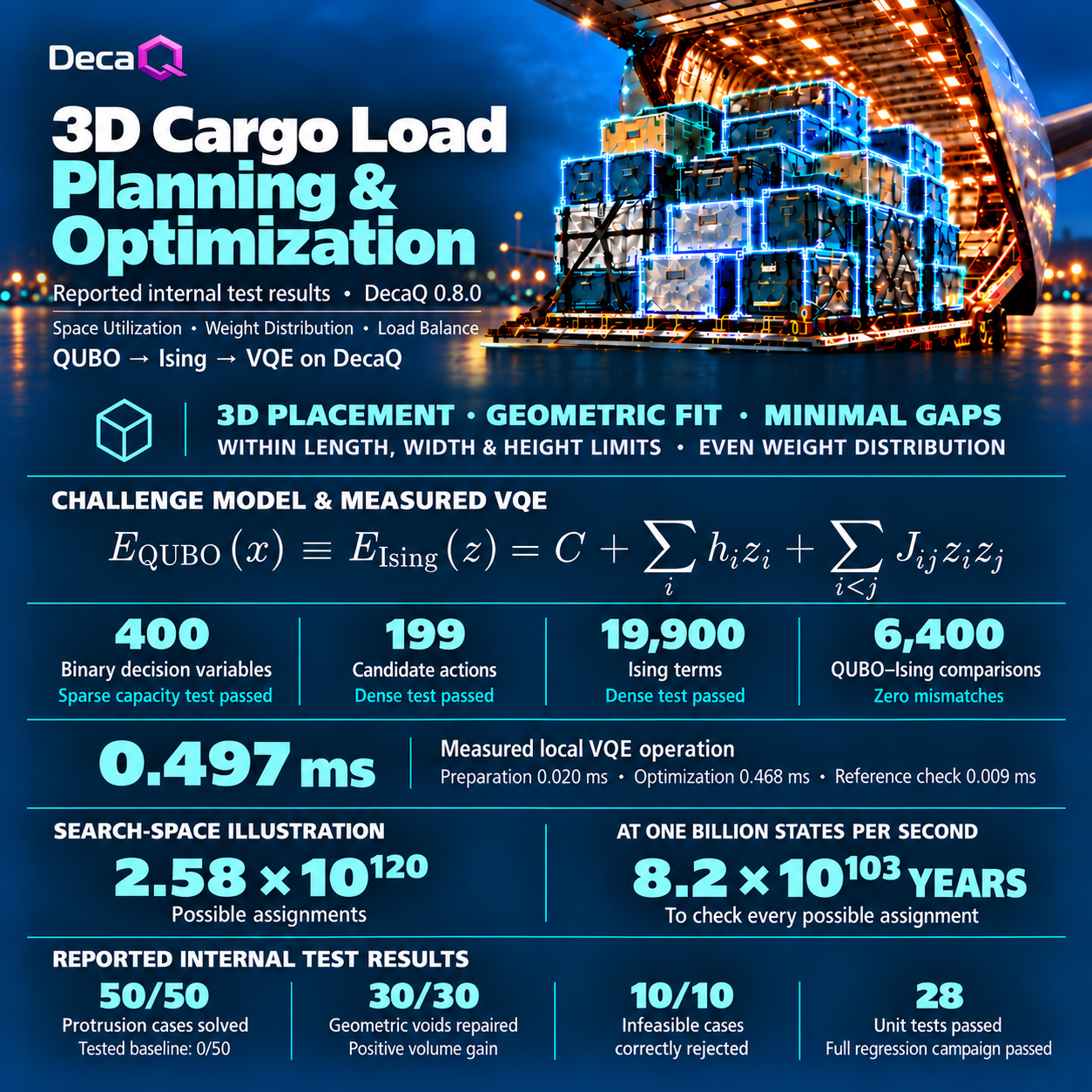
The engine takes cargo dimensions, weights and loading constraints as input. It models local placement and repair decisions as a QUBO optimization problem, converts that model into an Ising Hamiltonian, and uses VQE on DecaQ 0.8.0 to select actions.
The QUBO–Ising conversion preserves the optimization energy.
Selected actions feed directly into the packing engine, followed by separate physical-validity checks. This connects the optimization result to a checked physical arrangement.
Challenge model and validation:
400 binary decision variables: sparse capacity test passed.
199 candidate actions and 19,900 Ising terms: dense test passed.
6,400 QUBO–Ising comparisons: zero mismatches.
Measured local VQE operation: 0.497 milliseconds
This timing describes the reported local VQE operation; the capacity and dense tests are separate reported results.
Reported internal achievements
Local VQE: correct repair selected; exact optimum reached for the tested case.
50/50 protrusion cases solved, compared with 0/50 for the tested baseline.
30/30 geometric voids repaired, with positive volume gain.
10/10 infeasible cases correctly rejected.
28 unit tests and the full regression campaign: passed.
Two identical deterministic builds and clean-environment revalidation: passed.
58-file delivery archive: all files verified as valid.
Computational scale:
The binary model defines approximately 2.58 × 10^120 possible assignments.
at one billion states per second, checking every posible assignment would take approximately 8.2 × 10^103 years.
This illustrates the size of exhaustive search. It is not a measured runtime comparison with an optimized classical solver.
About DecaQ:
DecaQ develops Digital Quantum Computing technology powered by a Digital Quantum Oracle. Its cloud platform supports six algorithm families, including VQE and QAOA, and offers workflows for evaluating supported workloads, inspecting results and planning enterprise integration.
Apply the working solution to your operations
Companies facing cargo load planning, storage allocation or load-balancing challenges are invited to contact DecaQ.ai with their data and constraints.
Bring us your challenge. Apply a working solution — here and now.
DecaQ.ai
Contact Information:
DecaQ
Hello DecaQ
+972-033820954
Contact via Email
https://decaq.ai
Read the full story here: https://www.pr.com/press-release/980922
Press Release Distributed by PR.com