Intrinsic Therapeutics Announces Initial Release of Its Next Generation Barricaid Narrow Anchor Device Designed to Reduce Reherniation After Back Surgery
PR Newswire
BOSTON, March 4, 2026
BOSTON, March 4, 2026 /PRNewswire/ -- Intrinsic Therapeutics, Inc. has introduced the Barricaid® Narrow Anchor, the next generation of its FDA PMA-approved Barricaid® Bone-Anchored Annular Closure Device. The new version of the Barricaid device is 25 percent smaller than the standard Barricaid anchor. This updated device is designed to make implantation easier by reducing bony removal and nerve root retraction, thus increasing the number of high-risk patients that can benefit from a reduction in reherniation and reoperation after discectomy.
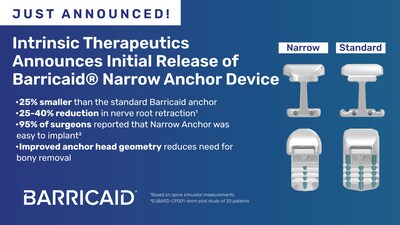
Reherniation is a common complication following lumbar discectomy, often leading to recurring pain and repeat surgeries. The Barricaid implant addresses this complication and is designed to close the defect in the disc wall and reduce the greatest risk factor for recurrence. The new Narrow Anchor maintains Barricaid's documented success but introduces significant design enhancements to streamline implantation during surgery. Link to video.
Greg Lambrecht, the founder of Barricaid, said of the new release, "Barricaid Narrow Anchor shortens the learning curve and ease of access for surgeons adopting annular closure, making the benefits of Barricaid available to more patients at high risk of recurrent disc and disability following a discectomy."
The Narrow Anchor reduces the bone anchor width from 8mm to 6mm, a change driven by surgeon feedback to improve ease of implantation. Potential benefits include:
- Reduced Retraction: Spine simulator measurements demonstrated a 25 to 40 percent1 reduction in nerve root retraction during implantation.
- Enhanced Visibility: Optimized anchor geometry improves a surgeon's view during placement.
- Easy to Implant: 95 percent of surgeons reported that the Narrow Anchor device was easy to implant2.
Despite the smaller footprint, the device passed the same mechanical testing criteria as the original 8mm anchor, including resistance to anchor migration and fracture.
"In practice, even small design changes can make a meaningful difference," said Robert Eastlack, MD, Professor and Division Head of Spine Surgery at Scripps Clinic. "The Narrow Anchor allows for easier implantation while accomplishing the same surgical goals, which can help streamline the procedure and expand the number of patients who may benefit from annular closure."
The Narrow Anchor launch follows recent momentum for Barricaid, including the American Medical Association's release of the 2026 CPT Code Set, which includes new CPT code 63032 describing bone-anchored annular closure, effective January 1, 2026.
About Barricaid
Barricaid is a proprietary annular closure medical device designed to reduce reoperations for reherniations by 81%3 in lumbar discectomy patients with large annular defects. Barricaid has been implanted in nearly 13,000 patients and is supported by clinical studies across eight distinct patient populations, including two randomized controlled trials and six single-arm studies. A multicenter, Level I RCT demonstrating superior outcomes to discectomy alone was published in JAMA with five-year follow-up results.
1.Based on spine simulator measurements
2. EUBARD-CP0001-6mm European pilot study of 20 patients
3. Some studies outside US indications. Values at minimum 1 yr post-op. Minimum study size of 20 Barricaid subjects.
Barricaid is a registered trademark of Intrinsic Therapeutics, Inc.
CPT is a registered trademark of the American Medical Association (AMA).
 View original content to download multimedia:https://www.prnewswire.com/news-releases/intrinsic-therapeutics-announces-initial-release-of-its-next-generation-barricaid-narrow-anchor-device-designed-to-reduce-reherniation-after-back-surgery-302703956.html
SOURCE Intrinsic Therapeutics, Inc.